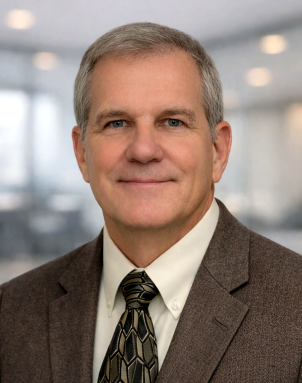
Edward L. Baker
Certified Forensic Video Analyst |Expert Witness | Consultant | Educator | Published Author | Retired Major Crimes Detective
Edward L. Baker is a retired Major Crimes Detective with more than 27 years of distinguished service with the Tacoma Police Department in Washington State. During his law enforcement career, he established the department’s first Forensic Video Analysis Unit and became one of the first nine individuals worldwide to earn certification as a Forensic Video Analyst.
For more than 25 years, Edward has specialized in the science and application of forensic video analysis, earning national and international recognition as a trusted authority in the field. As the founder of Video Consultants NW LLC, he provides advanced forensic video examination, consultation, expert witness services, and training to federal, state, provincial, and local law enforcement agencies, attorneys, prosecutors, and private organizations throughout the United States and Canada.
Edward regularly assists legal professionals, investigators, and organizations that rely upon digital evidence but do not possess the specialized technical expertise required to properly evaluate video authenticity, metadata, compression artifacts, image integrity, encoding processes, and evidentiary reliability. Through meticulous forensic examination and the ability to communicate highly technical concepts in understandable terms, he helps attorneys, judges, juries, and investigators interpret digital evidence within its proper investigative context. His work frequently involves video authentication, comparative image analysis, speed determination, gait and human factors analysis, critical incident reconstruction, and officer use-of-force investigations.
In addition to his forensic consulting work, Edward is a published author and co-author of Beyond the Frame: Bridging Digital Evidence with Reality in Force Investigations (2026). This professional reference examines the critical intersection of digital evidence, forensic video analysis, human performance, and force investigations. The publication explores the challenges associated with interpreting digital evidence within real-world investigative environments and provides practical guidance for investigators, attorneys, analysts, and decision-makers tasked with evaluating video evidence in complex and high-stakes cases. His contribution reflects a lifelong commitment to advancing professional standards while bridging the gap between technology, investigation, and courtroom presentation.
Edward further demonstrated this commitment through more than 14 years of service as a core instructor for the Law Enforcement and Emergency Services Video Association International (LEVA International). During that time, he co-instructed three of LEVA’s four intensive forensic video certification courses and served as both Vice President and President of the organization. His leadership helped shape certification standards, training methodologies, and best practices that continue to influence forensic video analysts throughout the world.
Beyond his work as an instructor, Edward developed and currently teaches an advanced online video examination course designed specifically for investigators, attorneys, forensic analysts, and practitioners working in both the public and private sectors. Through training, mentorship, consulting, and authorship, he continues to educate professionals responsible for evaluating and presenting digital evidence.
Edward has also made significant contributions to the advancement of forensic technology and digital evidence examination software. Over the course of his career, he has served as a subject matter expert, consultant, beta tester, and co-designer of forensic software applications and analytical workflows used by investigators and forensic laboratories worldwide. Working alongside industry-leading technology companies, software engineers, and forensic practitioners, he has helped conceptualize, evaluate, refine, and implement features for forensic video analysis platforms, image enhancement tools, artificial intelligence-assisted analytical systems, and digital evidence management solutions.
His collaborative efforts with organizations including Axon, Ocean Systems, YottaGeek, and other forensic technology innovators have directly influenced the development of software capabilities used to authenticate video evidence, enhance imagery, conduct forensic measurements, manage digital evidence, and improve investigative workflows. By combining practical investigative experience with technical expertise, Edward has helped bridge the gap between software developers and end users, ensuring that emerging technologies meet the evidentiary and operational needs of investigators, analysts, and legal professionals.
Throughout his career, Edward has served in numerous public safety and investigative roles, including first responder, rescue coordinator, fatality collision investigator, crisis negotiator, public information officer, and major crimes detective. Combined with more than four decades of professional experience, these assignments have provided a unique perspective that integrates investigative practice, forensic science, technology, human performance, and courtroom testimony.
Today, Edward’s unique combination of experience as a detective, forensic video analyst, educator, consultant, expert witness, software development collaborator, industry leader, and published author uniquely positions him to assist attorneys, prosecutors, law enforcement agencies, corporations, and organizations facing complex questions involving digital evidence. Through investigations, consultation, teaching, technology development, leadership, and authorship, he continues to help professionals bridge the gap between digital evidence and real-world understanding.
His expertise is perhaps best reflected in the Hebrew concept of Chokmah; the integration of knowledge, skill, understanding, judgment, and wisdom acquired through decades of practical experience and service.
“Those that know, do. Those that understand, teach.”
— Aristotle

